QUICK NAVIGATION
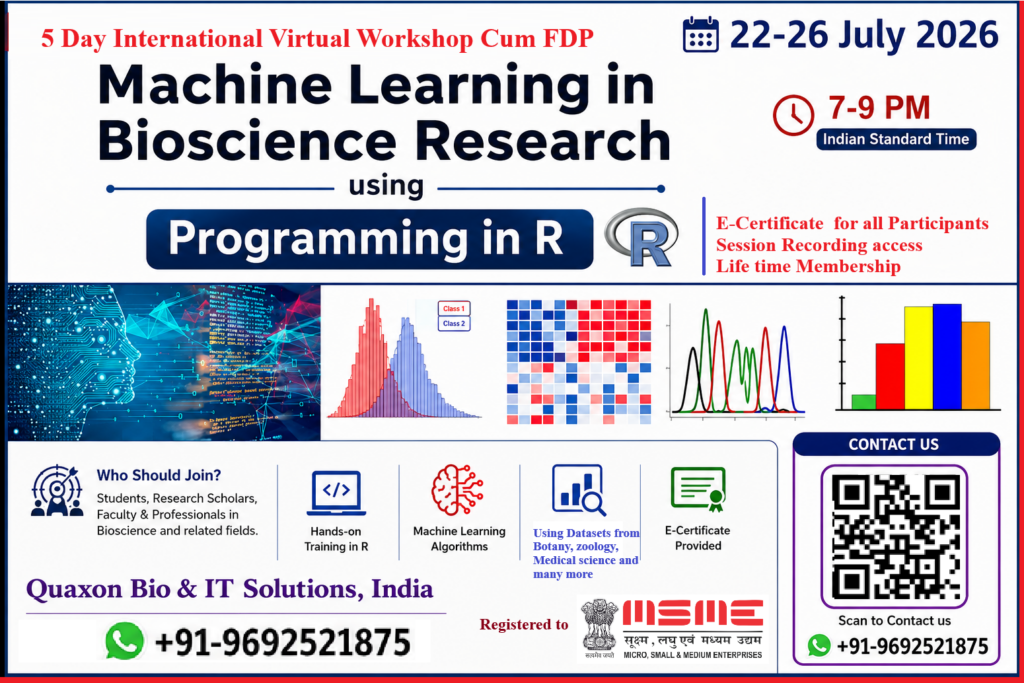
Quaxon Bio & IT Solutions, India is going to conduct it’s 79th international virtual workshop-FDP on Data Analaysis and Machine Learning in Bioscience Research using Programming in R
Date: 22th to 26th July 2026
Time: 7 PM to 9 PM IST Platform : Virtual with Recording access
check the schedule in your time zone at below link
https://savvytime.com/converter
Early Bird Registration valid till 20th July 2026
Eligibility:
Students, Research scholars, Faculties from all bioscience disciplines (Botany, zoology, microbiology, Biotechnology Bioinformatics, clinical research fellows and other allied fields) having basic computer operations skill are eligibility to participate
ABOUT THE THEME TOPIC
R programming for Data Analysis and Machine Learning in Bioscience Research
R is a powerful programming language widely used for statistical computing, data analysis, and visualization. Its open-source nature and vast collection of packages make it an excellent tool for analyzing complex biological datasets such as genomic, proteomic, and clinical data.
R also widely used for machine learning techniques like classification, clustering, and predictive modeling, helping researchers discover patterns and generate meaningful insights from data. Learning R has therefore become an essential skill for bioscience researchers in today’s data-driven research environment.
About this Workshop-Faculty Development Programme
This 5-day hands-on workshop design carefully for both beginners as well as intermediate experts. The participants will learn R programming from the beginning followed by Exploratory Data Analysis, essential statistics for ML. Participants will learn how to apply important machine learning techniques such as classification, clustering, and predictive modelling using real biological datasets.
Through guided exercises, attendees will explore how R can be used for statistical analysis, data visualization, and building predictive models from various Biological cases. The sessions will be purely interactive, with personalized guidance to help participants clearly understand each concept and its practical application.
By the end of the workshop, participants will gain the essential skills to apply machine learning methods using R in their own research.
.
Complete curriculum
Day 1 – Introduction to R and R Studio
Goal: Make beginners comfortable with R and biological datasets.
- Introduction to AI/Machine Learning in Bioscience
- Applications in Bioscience Research/
- Some key Case studies
- Introduction to R environment
- RStudio interface
- Installing and loading packages
- Basic R programming
- Variables and data types
- Vectors, matrices, data frames
- Importing datasets
- CSV / Excel data
- From Internet
- Basic data exploration
- Basic visualization
- Histograms
- Boxplots
- Scatter plots
Loading and exploring few sample Biological dataset
Day 2 – Data prepressing /Cleaning and essential statistics for Machine Learning
Goal: Data prepressing and essential statistics for ML.
Essential statistics for ML
- Mean, median, standard deviation, variance, Correlation analysis, Data distribution, outlier detection
Data pre-processing
- Handling missing values(various methods)
- Data normalization / scaling
- Feature selection and its importance
Data visualization and interpretation
- Correlation heatmap, using various plot to visualize the data
Introduction to ML workflow
- Training vs testing dataset
- Cross-validation concept
Day 3 – Machine Learning Workflow in R
Goal: Understanding ML pipeline before applying models.
- Introduction to caret package
- Preparing dataset for ML
- Splitting data into training and testing sets
- Feature engineering
- Model training concept
- Model prediction
- Performance evaluation concepts
Evaluation metrics introduction
- Accuracy
- Precision
- Recall
- F1 Score
- Confusion Matrix
Day 4 – Supervised Machine Learning
Goal: Predict on known level dataset
Classification algorithms
- Decision Tree
- Random Forest
- k-Nearest Neighbors (kNN)
- Logistic Regression
Practical examples
- Disease prediction dataset
- Gene expression classification
Model evaluation
- Confusion Matrix
- Accuracy calculation
Model comparison
Day 5 – Unsupervised Machine Learning
Goal: Discover patterns in biological data. Train from unlabelled data
Clustering techniques
- k-means clustering
- Hierarchical clustering
Dimensionality reduction
- Principal Component Analysis (PCA)
Anomaly Detection
- Identifies unusual or abnormal patterns in data.
Biological applications
- Species clustering
- Gene expression clustering
- cancer type classification
Case Study
Following are the case study included in this workshop(Including some Simulated dataset) (not limited to )
- Iris Flower Dataset: Species Prediction based on sepal, petal measurement
- Wisconsin Breast Cancer Dataset
- Pima Indians Diabetes Dataset
- NCI60 Cancer Cell Line Gene Expression Dataset
- Golub Leukemia Gene Expression Dataset
- Parkinson’s Disease Dataset
- Heart Disease (Cleveland) Dataset
- TCGA Cancer Genomic Dataset
- dentification of bio marker gene for cancer baed on gene expression data
- Predict Blood-Brain barrier of drug like compound by molecular descriptor
Steps to Participate
Step-1: Pay the participation fee as per your category
Participation fee category wise
| Category | for Indians | For International Participants |
| Students | Rs. 1000/- | $25 |
| Research Scholar/PhD Scholar | Rs. 1100/- | $30 |
| Faculty/PDF/ Other Job holders | Rs.1200/- | $35 |
Call/WhatsApp: +91-9692521875 for any kind of Information
Payment Link for Indians
Payment link for International Participants

Step-2: Fill up the registration form in this link below(After Payment)

About us
Quaxon Bio & IT Solutions is a fastest growing EduTech start-up established and registered to the Ministry of Micro, Small and Medium Enterprises, Government of India. Our mission is to act as an industry-academic interface, to excel in knowledge transformation and producing a highly skilled workforce equipped with next-generation technology. We are delivering high demand skills via virtual workshop on bioinformatics and data science with international participants, facilitating the exchange of cutting-edge research and ideas around the globe.
Contact us for any queries
Click to WhatsApp/Call +919692521875 or write to us support@qbiits.org
QUAXON BIO & IT SOLUTIONS, INDIA, REGISTERED TO

General Term and Conditions
- Please provide accurate details in the registration form to ensure smooth communication and certificate processing.
- Participants are requested to upload a valid Student/Research/Professional ID for verification and certificate authenticity.
- In rare situations beyond our control, the schedule may be adjusted. Participants will be informed promptly through email/phone.
- Quaxon Bio & IT Solutions reserves the right to ensure a professional and suitable learning environment for all participants. In exceptional cases where participation cannot be approved, the registration fee will be refunded.